What Do Tubular Breasts Look Like? Real Examples and Diagnosis Guide

Published by
Elena Prousskaia
Tubular breasts, also known as tuberous breast deformity, are not a disease but an abnormal development caused by a fibrous ring of tissue restricting natural breast growth during puberty.
This condition often becomes apparent as breasts take on a narrow, elongated shape with distinctive features such as a high inframammary fold and herniated areolas. Understanding what tubular breasts look like and how they can be diagnosed is the first step towards exploring effective treatment options.
In this guide, we will walk you through the key characteristics, severity classifications, real-life examples, and the expert surgical solutions offered by leading breast specialists like Elena Prousskaia.
Whether you are seeking to treat tubular breasts or simply want to learn more, this guide provides trusted, detailed information to help you make informed decisions about your breast health and aesthetics.
The Key Takeaways
- Tubular breasts have a narrow base, cone-like or tube-like shape, high breast fold and often puffy, enlarged areolas, creating a pointed rather than rounded appearance.
- Tuberous breast deformity is a congenital condition present from birth that becomes visible during puberty when a fibrous ring of tight breast tissue restricts normal breast development.
- The condition is fairly common, not dangerous or cancerous, but can significantly affect confidence, body image, and overall quality of life for many women.
- Tubular breast correction is complex reconstructive surgery requiring specialist expertise, which is a recognised area of practice for UK consultant plastic surgeon Elena Prousskaia.
- This article covers how to recognise tubular breasts, how severity is typically classified, real case examples, and modern surgical options available in the UK.
What Are Tubular Breasts and Why Do They Look Different?
Many women first notice their breasts look different in their teens or early twenties. They describe their breasts as “pointed,” “empty at the bottom,” or positioned unusually far apart. This discovery can be deeply distressing, affecting everything from clothing choices to intimacy.
Tubular breasts, also known as tuberous breasts or breast hypoplasia, are characterised by a constricted base, elongated shape, and often a high breast fold, leading to a pointed appearance. This is a congenital condition that is present from birth, but it typically becomes noticeable during puberty when the breasts fail to develop normally.
During puberty, a tight fibrous ring in the connective tissue prevents the breast from expanding horizontally across the chest wall. Instead, breast tissue projects forward in a tube like shape. Many individuals with tubular breasts experience embarrassment, low self esteem, and social anxiety due to the condition’s appearance. Women often avoid swimming costumes, intimacy, or fitted clothes.
It is widely acknowledged that tubular breasts are not just a cosmetic issue but can significantly affect an individual’s overall quality of life. The good news is this is a recognised medical condition that an experienced specialist breast surgeon such as Elena Prousskaia can treat with tuberous breast surgery.
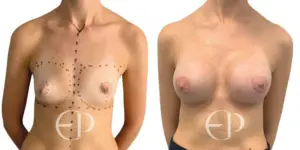
Discover more examples in our full before and after gallery
How to Identify Tubular Breasts
Use this checklist to understand the visual signs of constricted breasts. You may have one or multiple characteristics:
- The breast sits on a small “footprint” on the chest, failing to spread naturally towards the centre or sides.
- Rather than a rounded or teardrop curve, breasts begin projecting forwards in a cone or tube, often described as “pointy.”
- The crease where the breast meets the chest sits unusually high, making the lower pole appear very short.
- Minimal breast tissue in the lower half, especially the inner quadrant, so the nipple seems close to the fold with a saggy appearance.
- Breast tissue pushes through the nipple-areola complex, creating bulging, stretched areolas that look enlarged.
- One breast is often larger, more constricted, or droopier than the other, sometimes differing by more than one cup size.
- Common signs include a gap larger than 1.5 inches between the breasts, making natural cleavage impossible.
The severity of tubular breast characteristics can range from mild to significant, with some individuals presenting with one or multiple features such as asymmetry and sagging. The unusual shape and lack of symmetry can make it challenging to find properly fitting clothing and bras, leading to feelings of frustration and sadness.
A formal diagnosis should always be made by an experienced plastic surgeon during a face-to-face examination, as some women may only show a few of these signs.
Understanding the Severity
Surgeons use classification systems such as von Heimburg or Gandy-von Gadow to describe how severely the breast is constricted. Studies suggest this helps plan whether tissue remodelling alone is enough or whether tissue expanders and implants will be needed, reflecting our current understanding of the causes and development of tubular breast deformity.
|
Many women fall between categories. Elena uses her clinical judgement rather than relying solely on a label when creating a tailored treatment plan for each patient.

Discover more exceptional before and after procedure photos here
Why Do My Breasts Look This Way?
The exact cause of tubular breasts is not fully understood, but it is believed to arise from a developmental abnormality in the connective tissue of the breast during puberty, which prevents normal expansion and growth; understanding this helps patients considering tuberous breast correction in Bristol and the wider UK.
The fibrous ring
A band of collagen-rich tissue forms around the breast base, preventing normal horizontal expansion. This tight connective tissue pushes breast tissue forwards instead of outward, creating the characteristic irregular shape.
Effect on the areola
Because the constricted base is tight, glandular tissue tends to herniate through the weaker area of the areola, resulting in the characteristic puffy or domed appearance.
Hereditary aspects:
Recent research does suggest a genetic link, as tubular breasts can appear in several family members. However, no single causative gene has been identified.
Common myths debunked
Tight bras, weight training, poor posture, diet, or sleeping position do not cause tubular breasts and cannot reverse the fibrous ring. Exercise and good bra support improve comfort but will not change the underlying breast deformity.
The condition often does not pose a health risk but can affect the ability to breastfeed due to limited glandular tissue, which is also discussed in detail for women exploring tuberous breast correction surgery in Bristol.
How is Tuberous Breast Deformity Corrected?
Corrective surgery aims to widen the base, fill the lower pole, normalise the areola, and improve symmetry using reconstructive principles rather than simple breast enlargement.
Common methods used by Elena include:
- Tissue remodelling: Internal scoring or division of the fibrous ring allows the lower pole to expand, reshaping the breast from inside. This typically correct the constriction at the base.
- Areola reduction: Reducing the diameter and anchoring tissue beneath corrects the “puffy” look and centralises the nipple.
- Fat transfer: In selected cases, the patient’s own fat, taken by liposuction, adds subtle volume to specific areas.
- Breast implants: Used when there is significant volume deficit or the patient wants to be larger. Some mild tubular breasts can be corrected without implants, while others benefit from various implant sizes.
- Breast lift (mastopexy): Lifting and reshaping the breast envelope addresses droop or major asymmetry, often combined with implant or fat transfer.
Correction of tuberous breasts can be performed in one stage, where the constriction band is released and implants are inserted, or in two separate operations to reduce risks and complications. Elena will always discuss your treatment options, recovery time, and more in detail during your consultation.
Why Choose Elena Prousskaia for Tubular Breast Correction?

Elena Prousskaia is a UK Board-Certified Consultant Plastic Surgeon with extensive breast reconstruction expertise, combining advanced training with a personalised, patient-centred approach.
Tubular breast correction is more complex than standard cosmetic surgery and benefits from a specialist reconstructive approach, so it is important to choose the best tuberous breast surgeon in the UK.. With over 20 years of aesthetic plastic surgery experience, Elena has held advanced microsurgical breast reconstruction fellowships in Italy, Spain, Belgium, India, Japan, and London. Elena is also on the GMC Specialist Register and is a member of BAPRAS and EBOPRAS.
Many women seek treatment for tubular breasts for cosmetic reasons to improve self esteem and body confidence. If you are in England, particularly around London, Bristol, or Somerset. Consider booking a consultation to discuss tuberous breast correction with Elena and explore your options between NHS and private tubular breast treatment.
Frequently Asked Questions
At what age can tubular breasts be diagnosed and treated?
The condition usually becomes clear a few years after puberty, when breast development has stabilised. Surgery is typically considered once patients reach 18 and breast size is stable. Elena routinely assesses young adult patients who feel uncomfortable with their breast shape since adolescence. A mental health professional may also support patients experiencing significant emotional impact.
Will tubular breast surgery affect future breastfeeding?
Many women with tubular breasts can breastfeed, but milk supply may be limited if there is very little glandular tissue. Elena’s surgical techniques aim to preserve breast tissue and ductal connections, but no surgeon can guarantee breastfeeding ability after any breast surgery. Women who hope to breastfeed should discuss this openly during consultation.
How long is the recovery after tubular breast correction?
Most patients return to desk-based work in about 1 to 2 weeks and avoid heavy lifting for 4 to 6 weeks. The final breast shape settles over several months. Elena provides personalised aftercare instructions, including guidance on support bras and gradual return to exercise. Follow-up visits at 1, 4, and 12 weeks monitor healing.
Can tubular breasts come back after surgery?
Once the fibrous ring has been properly released and the breast reshaped, the breast deformity does not “grow back.” However, breasts will still change with age, weight, and pregnancy. Implants may eventually need replacement as part of normal long-term care. Choosing a surgeon experienced in true tuberous breast surgery ensures stable, long-lasting results.
How do I arrange a consultation with Elena Prousskaia?
Contact Elena’s private practice directly through the enquiry options on the elenaprousskaia.com website to book a confidential consultation. Appointments are available at the fully bespoke North Bristol Private Hospital. Bring any previous imaging, medical history, and questions to make the most of your appointment time. Many patients find that taking this first step helps them seek treatment with greater confidence.
Share this article
Back to Advice Centre