
An FUE hair transplant involves extracting individual hair follicles from a donor area, typically the back or sides of the scalp, and implanting them into thinning or balding regions. This follicular unit extraction technique is minimally invasive and avoids the linear scarring associated with older strip methods. The result is a natural appearance that blends seamlessly with your existing hair once fully grown.
This practical, time-based guide walks you through FUE hair transplant recovery at North Bristol Private Hospital.
The key takeaways:
- Most patients feel presentable after about 10 to 14 days, but hair growth continues to improve for 9 to 12 months after the procedure.
- Transplanted hairs often shed in the first 4 to 8 weeks before new growth starts around months 3 to 4, which is completely normal.
- Following the specific aftercare plan provided at North Bristol Private Hospital protects grafts and reduces infection risk significantly.
- Elena Prousskaia refers patients for FUE hair transplant at North Bristol Private Hospital, where all hair transplant surgery takes place under the care of a specialist surgical team.
- The donor area heals rapidly with FUE, leaving only tiny puncture marks that become nearly invisible under surrounding hair.
Exploring the Immediate Post-Operative Period (Day 0)
Surgery at North Bristol Private Hospital concludes with the local anaesthetic gradually wearing off. Your scalp may feel numb, tight, or mildly tender as sensation returns. The medical team will ensure any bandages or dressings are properly positioned before discharge.
The transplanted area will display small red dots where the new hair follicles have been placed. These tiny marks are perfectly normal and indicate where each graft now sits beneath the skin surface. The donor area, usually at the back or sides of your head, may feel tender with visible pinpoint extraction marks.
Before leaving the hospital, you receive comprehensive written and verbal aftercare instructions covering:
- How to position your head during sleep
- When and how to take any prescribed pain relief or antibiotics
- How to care for dressings in the first hours
- Warning signs that would require contact with the team
Most surgeons recommend sleeping with your head elevated on the first night. This helps limit swelling and prevents pressure on the sensitive grafts. Using extra pillows or a wedge cushion keeps your head in the optimal position while you rest.
Patients leave North Bristol Private Hospital on the same day in most FUE cases. The team schedules an early review, often within days, to check graft security and address any immediate concerns about the healing process.
Early Healing: Days 1 to 7
The first week is when your hair grafts are at their most vulnerable. Scabbing and mild swelling are most noticeable during this period, and careful attention to post operative care instructions makes a significant difference to outcomes.
Typical appearances during days 1 to 7 include:
- Small scabs forming around each graft in the recipient area
- Mild redness and slight discomfort where follicles have been implanted
- Dotted marks in the donor area from FUE harvesting
- Possible mild oedema (swelling) around the forehead or temples
Rest is essential. We often advise patients to avoid strenuous activity and avoid bending the head down for long periods. This protects blood circulation and blood flow to the newly transplanted hair follicles, giving them the best chance to establish themselves.
Careful hair washing may start after the first couple of days,this generally involves:
- Pouring lukewarm solution gently over the scalp
- Avoiding any direct rubbing or pressure on grafts
- Patting the area dry with a clean, soft cloth
- Using only clinic-recommended shampoos or lotions
Temporary itching, tightness, or slight oozing can occur during this recovery period. These sensations are normal parts of the healing process. Use only the products and medications recommended by your surgical team to prevent infection and protect your sensitive grafts.
Settling In: Days 8 to 14
By the second week, the scalp usually feels more comfortable. The transplanted hair follicles are becoming more secure in their new location, and the initial intensity of the healing process begins to ease.
Scabs will normally start to soften and fall away gradually as you continue your gentle washing routine. Redness should steadily fade, although patients with sensitive skin may retain some pinkness slightly longer than others.
Important reminders for days 8 to 14:
- Do not scratch or pick at any remaining crusts
- Continue the recommended washing technique
- Avoid touching or manipulating the recipient area unnecessarily
- Keep the scalp protected from direct sunlight
A follow-up appointment, either in person or remote, is often arranged around the end of the second week. This allows the North Bristol Private Hospital team to confirm that healing is on track and address any questions about the next stages.
Quiet Phase and Shedding: Weeks 3 to 8
From around week 3 onwards, many of the transplanted hairs fall out. This process, called shock loss, affects roughly 70 to 80 percent of transplanted hair strands. The hair shedding is a normal part of the natural growth cycle as follicles enter a dormant telogen stage, or resting phase, before eventually producing new permanent growth.
The crucial point to understand: while the hair shafts fall out, the transplanted follicles beneath the skin remain alive and well. They are simply resetting before beginning their anagen (active growth) phase.
By this time, the scalp surface should look fully healed:
- Scabs are gone
- Only mild pinkness may remain in some patients
- The procedure becomes much less noticeable day to day
- The donor area conceals well under existing hair
If anything looks unusual during this shedding period, such as increasing pain, spreading redness, or discharge, contact the North Bristol Private Hospital team promptly. These symptoms are rare but should be assessed quickly.
Patients can usually expand their activities gradually during this period. Continue to avoid direct trauma to the scalp and follow any ongoing restrictions on sun exposure or hair products. Swimming, saunas, and contact sports should still be avoided as advised.
Early New Growth: Months 3 to 5
This is when the first visible signs of new hair growth commonly appear. The waiting is finally rewarded with tangible progress, although timing can vary slightly between individuals.
Fine, wispy hairs begin to emerge in the transplanted area. These initial hair strands start growing at approximately 1 centimetre per month. They often look softer or lighter at first compared with your natural hair, which is completely normal at this stage.
At this stage, many patients can treat their hair more normally:
- Gentle styling is usually permitted
- Cautious use of standard hair products may be allowed
- Normal washing routines can typically resume
- Hair care becomes less intensive
Thickening Phase: Months 6 to 8
By around 6 months, many hair transplant patients see a noticeable improvement in coverage and hairline definition. Everyday photographs and mirrors start reflecting meaningful change.
The transplanted hairs usually become thicker and stronger through this period. This increase in hair density helps the new hair blend more naturally with surrounding non-transplanted hair, creating the seamless integration that makes FUE results so appealing.
Progress at months 6 to 8 typically includes:
| Area | Expected Progress |
|---|---|
| Recipient zone | Improved coverage, better definition, thicker hair strands |
| Donor area | FUE extraction sites faded, hidden by regrowth |
| Overall appearance | More natural blending with existing hair |
| Scalp health | Fully healed, no restrictions on contact |
The donor scars from FUE fade completely by this point. The tiny extraction marks are hidden by surrounding hair growth, making them virtually invisible at normal hair lengths.
Most people can resume a full range of daily activities and exercise at this stage, subject to any individual advice from the clinical team. Realistic expectations remain important, as further improvement in texture and density can still occur beyond month 8.
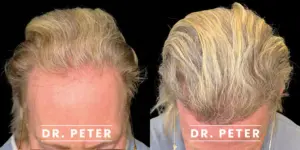
See more amazing before and after results here
Final Results: Months 9 to 12 and Beyond
From around 9 to 12 months after hair transplant, the majority of cosmetic benefits are usually apparent. This is when hair transplant results truly shine.
Hair in the transplanted area should now have a more mature character:
- Greater thickness and calibre
- Improved coverage across the recipient area
- Consistent blend with your natural hairstyle
- Uniform hair density throughout treated zones
Minor refinements continue beyond the one-year point for some patients. Subtle changes in density and texture occur as the transplanted follicles complete further growth cycles and fully stabilise. Some patients see continued improvements up to 18 months post-procedure.
A one-year follow-up is often recommended to evaluate the result. This appointment allows the team to:
- Compare current appearance with pre-treatment photographs
- Assess overall hair density and coverage
- Discuss any future hair restoration planning if required
- Address questions about long-term hair care
Because the new hair follicles are taken from donor regions that tend to be more resistant to hair loss (they are DHT-resistant), results are intended to be long-term. However, ongoing natural ageing and hair loss in non-transplanted areas can still occur, which is why some patients consider additional sessions in future years.
Aftercare and Lifestyle Tips for Better Recovery
Careful aftercare in the first weeks has a significant effect on comfort, infection risk, and the appearance of any scarring. Following your personalised plan from North Bristol Private Hospital optimises graft survival and supports healthy hair growth.
Key aftercare advice typically provided:
| Category | Recommendation | Duration |
|---|---|---|
| Cleansing | Use clinic-recommended shampoo with gentle technique | First 2 to 4 weeks |
| Smoking | Avoid completely | Early healing phase |
| Alcohol | Avoid completely | 2 weeks pre and post surgery |
| Sun exposure | Protect scalp, wear loose hat if outdoors | First 4 to 6 weeks |
| Swimming/saunas | Avoid completely | First 4 weeks minimum |
| Contact sports | Avoid | First 4 to 6 weeks |
Patients should avoid swimming, saunas, and contact sports for a defined period after surgery. These activities increase infection risk and can cause direct trauma to grafts before they are fully secure.
Attending all scheduled appointments at North Bristol Private Hospital ensures any concerns are addressed early. Signs to watch for and report promptly include:
- Unusual or increasing swelling
- Severe pain that does not respond to prescribed medication
- Signs of infection such as spreading redness, warmth, or discharge
- Any concerns that feel out of the ordinary
Maintain realistic expectations throughout your recovery and hair growth journey. Every patient heals at their own pace, and comparing your progress to others can create unnecessary anxiety. Trust the process, follow your personalised plan, and contact the hospital team promptly if anything concerns you.
Considering an FUE Hair Transplant with Elena Prousskaia and North Bristol Private Hospital
Patients interested in FUE hair transplant can arrange a consultation through Elena Prousskaia to explore whether this treatment is suitable for their pattern of hair loss and overall health. The consultation provides a thorough assessment of your individual situation.
All hair transplant operations are carried out at North Bristol Private Hospital, an independent CQC-registered hospital offering a range of cosmetic and reconstructive treatments.
During your consultation, you can discuss your goals, likely graft numbers, donor viability, and how the expected hair transplant recovery timeline would fit around work and family commitments. The team assesses factors including donor density, scalp health, and any conditions that might affect suitability.

Finance options, including 0 percent finance, may be available for eligible patients. This makes high-quality hair restoration surgery accessible to more people seeking to address their hair loss concerns.
Ready to take the next step?
Book a consultation to arrange an individualised assessment and a personalised recovery plan rather than relying only on general timelines. Your hair restoration journey deserves expert guidance from start to finish.
Frequently Asked Questions
Will I have visible scarring after an FUE hair transplant?
FUE harvesting at North Bristol Private Hospital is designed to leave multiple tiny circular extraction sites in the donor area rather than a single linear scar. Unlike follicular unit transplantation methods that remove a thin strip of scalp, FUE creates only pinpoint marks.
Once healed and covered by surrounding hair, these small marks are usually very difficult to see in day-to-day life, especially at typical hair lengths. The exact visibility depends on factors such as hair length, hair colour contrast with the scalp, and the number of grafts removed.
Your surgeon will discuss likely scarring patterns in detail during consultation, including how different hairstyle choices may reveal or conceal the donor area.
How soon can I go back to work after my hair transplant?
Many patients feel able to return to desk-based work within about 7 to 10 days, once early scabbing has settled and redness has started to fade. The short recovery period for office workers is one advantage of the FUE technique.
People with physically demanding or outdoor jobs may be advised to take a little longer away from work. Sweat, dust, and accidental knocks to the scalp can affect healing and graft survival.
Discuss your exact role with the North Bristol Private Hospital team so that a tailored return-to-work plan can be agreed in advance. Some patients choose to work from home during the first week to balance rest, privacy, and productivity.
Can I cut or colour my hair during the recovery period?
Cutting hair in the donor area is usually possible before the transplant and again once the scalp has fully healed. The transplanted area should be treated very carefully for the first few weeks, with no cutting until the team confirms it is safe.
Most surgeons recommend avoiding chemical colour treatments on the transplanted region until the skin barrier has fully recovered. This typically means waiting several weeks or more after surgery.
Always check specific timing with your surgical team, as recommendations can vary depending on the extent of surgery and any individual skin sensitivities. Temporary styling solutions, such as careful changes in parting or length, can be discussed at follow-up visits.
What if I do not see much growth by month 4?
The timing of early growth can vary, and some patients see more noticeable changes closer to months 5 to 6 rather than month 3. This variation is perfectly normal and does not indicate a problem.
As long as the scalp has healed well and there are no signs of scarring alopecia or infection, slower visible change simply reflects your individual growth rates. Hair grows at different speeds for different people.
Attend your scheduled review at North Bristol Private Hospital so that the team can compare your current appearance with photos from before and shortly after surgery. If progress appears slower than expected, they can explore possible contributing factors and discuss realistic expectations.
Is an FUE hair transplant at North Bristol Private Hospital suitable for everyone with hair loss?
Not all types of hair loss are treated in the same way. Suitability depends on the cause of hair loss, pattern of thinning, and the quality of the donor area. Patients with androgenetic alopecia (pattern baldness) are often good candidates.
Conditions such as active inflammatory scalp disease or very limited donor hair may make surgery less appropriate. In these cases, alternative management may be recommended.
A detailed consultation and scalp assessment through Elena Prousskaia and the North Bristol Private Hospital team is essential before any decision about surgery. The goal is always to recommend a plan that is safe, sustainable, and in keeping with your long-term appearance and health.
Share this article
Back to Advice Centre